
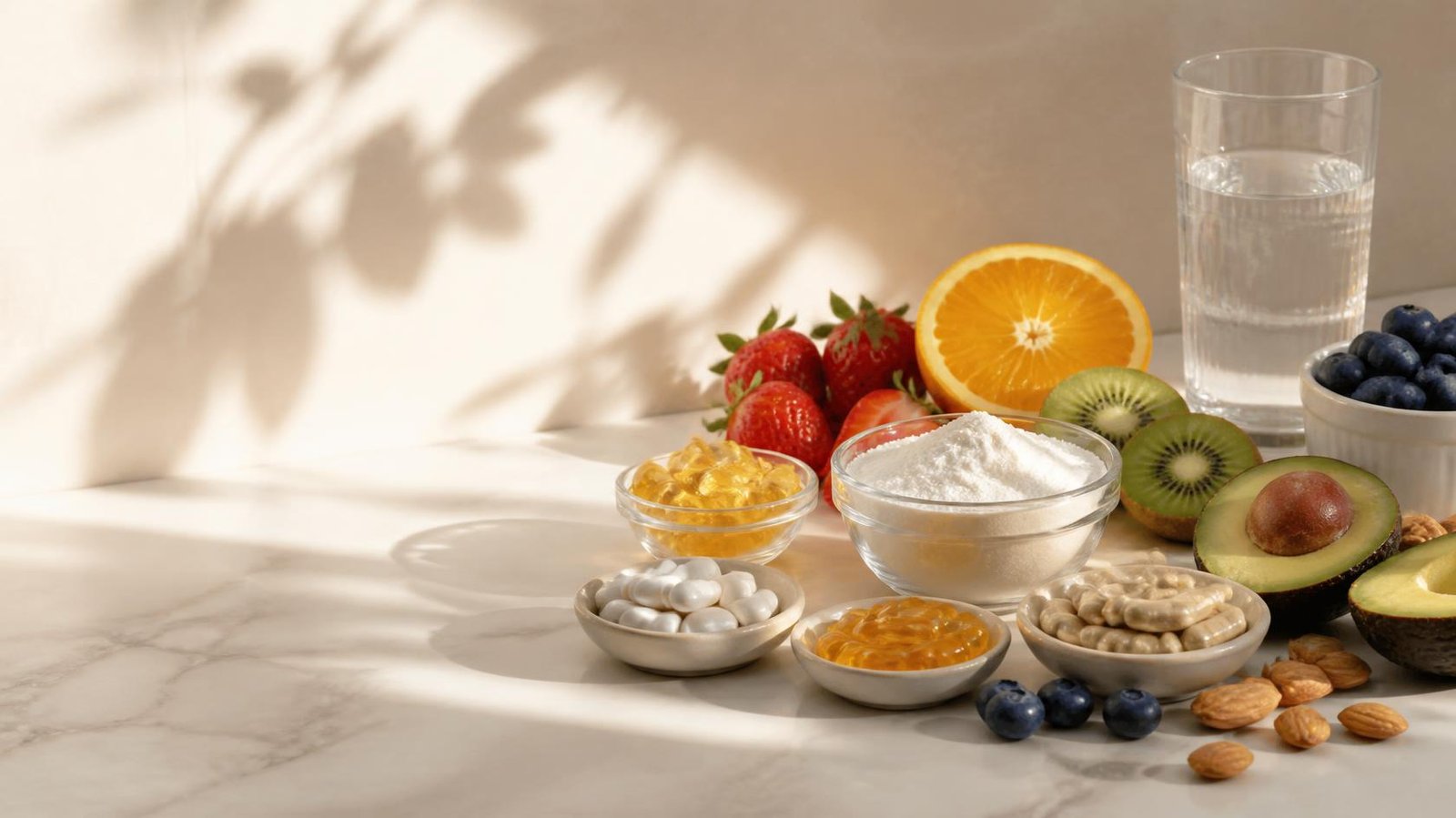
Glowing skin is often associated with an effective skincare routine, but healthy-looking skin starts from more than what you put on your face. Nutrition, hydration, sleep, sun protection, and overall health all play important roles in maintaining normal skin structure and function.
This is why supplements for glowing skin have become so popular. Products containing collagen, vitamin C, vitamin E, zinc, omega-3 fatty acids, hyaluronic acid, and biotin are widely marketed for beauty and skin health.
But there is an important distinction between supporting normal nutrition and expecting a supplement to transform your skin.
The American Academy of Dermatology recommends that healthy adults generally meet their nutritional needs through a balanced diet. Supplements may be useful when a person has a documented deficiency or another reason to need additional nutrients.
So, what are the best supplements for glowing skin?
In this guide, we’ll examine seven popular options, what they do in the body, what the evidence suggests, and what to look for before buying a beauty supplement.
Affiliate disclosure: This article contains affiliate links. If you purchase through qualifying links, we may earn a commission at no additional cost to you.
Quick Answer: What Are the Best Supplements for Glowing Skin?
The most commonly considered skin-support supplements include:
- Collagen peptides
- Vitamin C
- Vitamin E
- Omega-3 fatty acids
- Zinc
- Hyaluronic acid
- Biotin
However, these supplements are not equally supported by evidence, and not everyone needs them.
Your diet and nutritional status should guide your choices.
1. Collagen Peptides
Collagen is one of the most popular ingredients in beauty supplements.
It is a structural protein found throughout the body, including the skin, bones, tendons, and connective tissues.
As we age, natural collagen production changes. This has contributed to the popularity of collagen powders, capsules, and drinks marketed for skin elasticity and appearance.
The American Academy of Dermatology notes that consuming collagen through food or supplements may improve skin appearance, although more research is needed.
What are collagen peptides?
Collagen supplements commonly contain hydrolyzed collagen, also called collagen peptides.
Hydrolysis breaks collagen into smaller peptides that are easier to use in supplement formulations.
You can find collagen products made from:
- Fish
- Bovine sources
- Chicken
- Other animal-derived sources
What should you look for?
For an affiliate product comparison, look for:
- Clearly stated collagen source
- Amount of collagen per serving
- Minimal unnecessary ingredients
- Transparent labeling
- Independent testing when available
If you have a seafood allergy, pay particular attention to the source.
Amazon category
Shop Collagen Supplements on Amazon
Collagen is also a natural internal-link opportunity for an article such as “Best Collagen Supplements.”
2. Vitamin C
Vitamin C is one of the most relevant nutrients when discussing skin health.
The body needs vitamin C to produce collagen. It also functions as an antioxidant and helps protect cells from oxidative damage.
This makes vitamin C especially interesting for people looking to support normal collagen formation and overall nutrition.
Food sources of vitamin C
You don’t necessarily need a supplement to get vitamin C.
Good food sources include:
- Oranges
- Strawberries
- Kiwi
- Bell peppers
- Broccoli
- Tomatoes
- Potatoes
A balanced diet can provide substantial vitamin C.
Should you take a vitamin C supplement?
Not necessarily.
If your diet already provides enough vitamin C, taking large amounts is unlikely to provide an automatic “glow.”
Instead, consider supplementation as a way to address dietary gaps when appropriate.
For adults, the recommended dietary allowance is 75 mg per day for women and 90 mg per day for men, with higher needs during pregnancy and breastfeeding.
Amazon category
Shop Vitamin C Supplements on Amazon
3. Vitamin E
Vitamin E is another nutrient frequently included in beauty supplements.
It acts as an antioxidant and helps protect cells from oxidative damage.
Vitamin E occurs naturally in foods such as:
- Almonds
- Sunflower seeds
- Vegetable oils
- Spinach
- Other green vegetables
The NIH describes vitamin E as a group of fat-soluble compounds with antioxidant activity.
Vitamin E and glowing skin
Vitamin E is important for normal health, but that doesn’t mean a high-dose vitamin E supplement will automatically make your skin brighter.
If your diet already provides sufficient vitamin E, additional supplementation may not provide a visible cosmetic benefit.
This is another reason to evaluate the entire diet rather than choosing supplements based on beauty marketing alone.
Amazon category
Shop Vitamin E Supplements on Amazon
4. Omega-3 Fatty Acids
Omega-3 fatty acids are commonly found in fish oil supplements and are another popular ingredient in beauty and wellness products.
The American Academy of Dermatology lists omega-3 among nutrients commonly found in skin supplements and notes that omega-3s may help with dryness and irritation.
Where do omega-3s come from?
Common sources include:
- Salmon
- Sardines
- Mackerel
- Tuna
- Fish oil
- Algae-based supplements
- Certain nuts and seeds
For people who don’t regularly eat fatty fish, a supplement may be one option to discuss with a healthcare professional.
Fish oil or algae oil?
Fish oil generally provides EPA and DHA.
Algae-based products can provide DHA and may be an option for people who avoid fish.
When shopping, check exactly how much EPA and DHA the product contains rather than looking only at the total oil amount.
Amazon category
Shop Omega-3 Supplements on Amazon
5. Zinc
Zinc is an essential mineral involved in numerous processes throughout the body.
It also plays a role in maintaining normal skin and immune function.
Zinc can be found naturally in foods such as:
- Oysters
- Meat
- Poultry
- Beans
- Nuts
- Whole grains
- Dairy products
However, zinc supplementation isn’t automatically necessary for everyone.
The amount you need depends on age, sex, pregnancy status, and overall dietary intake.
Why is zinc included in beauty supplements?
Zinc is important for normal cellular processes and tissue maintenance.
However, taking large amounts doesn’t necessarily produce better skin.
Too much supplemental zinc can interfere with copper absorption and may cause adverse effects.
Therefore, look for sensible doses rather than extremely high-dose formulas.
Amazon category
Shop Zinc Supplements on Amazon
6. Hyaluronic Acid Supplements
Hyaluronic acid is widely known in skincare because of its ability to bind water.
You may already recognize it as an ingredient in:
- Moisturizers
- Serums
- Facial masks
- Eye creams
It is also available as an oral supplement.
Some beauty formulas combine hyaluronic acid with collagen, vitamin C, and other ingredients.
Is oral hyaluronic acid worth considering?
Research into oral hyaluronic acid for skin-related outcomes is still developing.
Therefore, it is better to view it as an optional beauty supplement rather than a guaranteed solution for glowing skin.
When comparing products, pay attention to:
- Amount per serving
- Other active ingredients
- Source
- Testing information
- Price per serving
Avoid products that make dramatic promises such as “erase wrinkles instantly.”
Amazon category
Shop Hyaluronic Acid Supplements on Amazon
7. Biotin
Biotin is a B vitamin involved in metabolism.
It is also heavily marketed for hair, skin, and nails.
However, this is an area where marketing can easily get ahead of the evidence.
The NIH states that there is little scientific evidence supporting biotin supplements for improving hair, skin, and nails in people without a deficiency.
The American Academy of Dermatology also cautions that biotin supplements should generally be considered when deficiency is present rather than simply used as a routine beauty supplement.
Important biotin warning
High-dose biotin can interfere with certain laboratory tests and potentially produce inaccurate results.
If you’re taking a supplement containing a large amount of biotin, tell your healthcare professional before having blood tests.
Amazon category
Shop Biotin Supplements on Amazon
How to Choose the Best Supplement for Glowing Skin
Choosing a supplement shouldn’t begin with the most attractive bottle or the biggest number on the label.
Instead, consider these five factors.
1. Start With Your Diet
Food should be the foundation.
A skin-friendly eating pattern can include:
- Colorful fruits
- Vegetables
- Lean proteins
- Fish
- Nuts
- Seeds
- Whole grains
- Healthy fats
Many nutrients found in skin supplements are already available through everyday foods. The AAD recommends a balanced diet as the primary way for healthy adults to obtain nutrients.
2. Look at the Supplement Facts Label
Don’t choose a supplement simply because it contains ten or twenty ingredients.
More ingredients don’t necessarily mean better results.
Check:
- Dosage
- Serving size
- Ingredient forms
- Added sugars
- Artificial ingredients
- Allergens
- Proprietary blends
A transparent label makes it easier to understand exactly what you’re purchasing.
3. Consider Third-Party Testing
Independent testing can provide additional confidence that the contents match the label.
The AAD recommends looking for reputable third-party verification such as USP, NSF, Underwriters Laboratories, or ConsumerLab when choosing supplements.
4. Avoid Mega-Doses
A common mistake is assuming that a larger dose will produce better skin.
That isn’t necessarily true.
Some nutrients can cause problems when taken in excessive amounts.
For example, high-dose biotin can interfere with laboratory tests, while excessive intake of certain minerals can cause adverse effects.
5. Be Careful With “Beauty Blends”
Some supplements contain a long list of ingredients with very small amounts of each.
Before purchasing, compare the actual dosage of each important ingredient.
A product with fewer ingredients and transparent amounts may be easier to evaluate than a proprietary blend.
Supplements vs. Skincare: Which Matters More?
Supplements shouldn’t replace a basic skincare routine.
For healthy-looking skin, consider the fundamentals:
Cleanse
Use a gentle cleanser appropriate for your skin type.
Moisturize
A moisturizer can help support the skin barrier and reduce dryness.
Use Sunscreen
Daily sun protection is one of the most important parts of maintaining healthy-looking skin.
Eat a Balanced Diet
A varied diet supplies many nutrients involved in normal skin function.
Sleep Well
Sleep supports overall health and recovery.
Supplements are best viewed as one possible component of a broader wellness routine.
Best Supplements for Glowing Skin: Comparison
| Supplement | Why It’s Popular | Important Consideration |
| Collagen | Skin structure and appearance | Evidence is still developing |
| Vitamin C | Collagen production and antioxidant function | Often available from food |
| Vitamin E | Antioxidant nutrient | Avoid unnecessary high doses |
| Omega-3 | Skin wellness and healthy fats | Check EPA/DHA content |
| Zinc | Normal skin and cellular function | Excess can cause problems |
| Hyaluronic acid | Hydration-focused beauty products | Oral evidence is developing |
| Biotin | Hair, skin, and nail marketing | Limited evidence without deficiency |
No single supplement is guaranteed to produce glowing skin.
Supplement Product Ideas
This product categories can create useful comparison opportunities:
Collagen Peptides
Content angle: Compare collagen source, serving size, flavor, added vitamin C, and price per serving.
Vitamin C
Content angle: Compare tablets, capsules, powders, and different formulations.
Omega-3
Content angle: Compare EPA/DHA amounts, serving size, fish source, and third-party testing.
Hyaluronic Acid
Shop Hyaluronic Acid Supplements
Content angle: Compare dosage and combination formulas.
Women’s Beauty Multivitamins
Shop Women’s Beauty Supplements
Content angle: Compare collagen, vitamin C, zinc, biotin, and other ingredients.
For affiliate compliance, use your own Amazon Associates tracking links rather than generic Amazon URLs when publishing.
Frequently Asked Questions
What is the best supplement for glowing skin?
There isn’t one supplement that is best for everyone. Collagen, vitamin C, omega-3s, zinc, vitamin E, hyaluronic acid, and biotin are commonly marketed for skin health, but their usefulness depends on diet, nutritional status, and individual needs.
Does collagen make skin glow?
Collagen supplements may improve some aspects of skin appearance, according to dermatology guidance, but more research is needed. They should not be presented as a guaranteed way to make skin glow.
Does vitamin C help skin?
Vitamin C is required for collagen production and acts as an antioxidant. Getting enough vitamin C is therefore important for normal skin and connective-tissue function.
Is biotin good for glowing skin?
Biotin is important for normal metabolism, but there is limited evidence that biotin supplements improve skin in people who are not deficient. High doses can also interfere with certain blood tests.
Can supplements replace skincare?
No. Supplements should complement, not replace, basic skincare habits such as moisturizing and sun protection.
How long do skin supplements take to work?
There is no universal timeline. Results depend on the supplement, the person’s nutritional status, the outcome being measured, and the underlying reason for taking it. Be cautious of products promising dramatic results within days.
Final Thoughts
The search for glowing skin often leads people toward supplements, but the best approach is more balanced.
Collagen, vitamin C, vitamin E, omega-3s, zinc, hyaluronic acid, and biotin all appear in the beauty-supplement market, but they shouldn’t be treated as interchangeable or universally necessary.
Vitamin C has a clear nutritional role in collagen production, while biotin has much weaker evidence for improving skin in people without deficiency.
For most healthy adults, a varied diet should remain the foundation of nutrition. If you are considering a supplement, look for transparent labeling, sensible doses, and independent quality verification. The American Academy of Dermatology specifically recommends discussing supplements with a dermatologist or other healthcare professional when there are questions about nutritional deficiencies, medications, or skin concerns.
Ultimately, glowing-looking skin is more likely to come from a complete routine than from one miracle supplement: nutritious food, adequate sleep, hydration, appropriate skincare, and consistent sun protection all matter.
Important: If you are pregnant, breastfeeding, taking medication, have a medical condition, or suspect a nutritional deficiency, consult a qualified healthcare professional before starting a new supplement.